


HYROX Sled Push — Why It Breaks Races and How to Train It Right
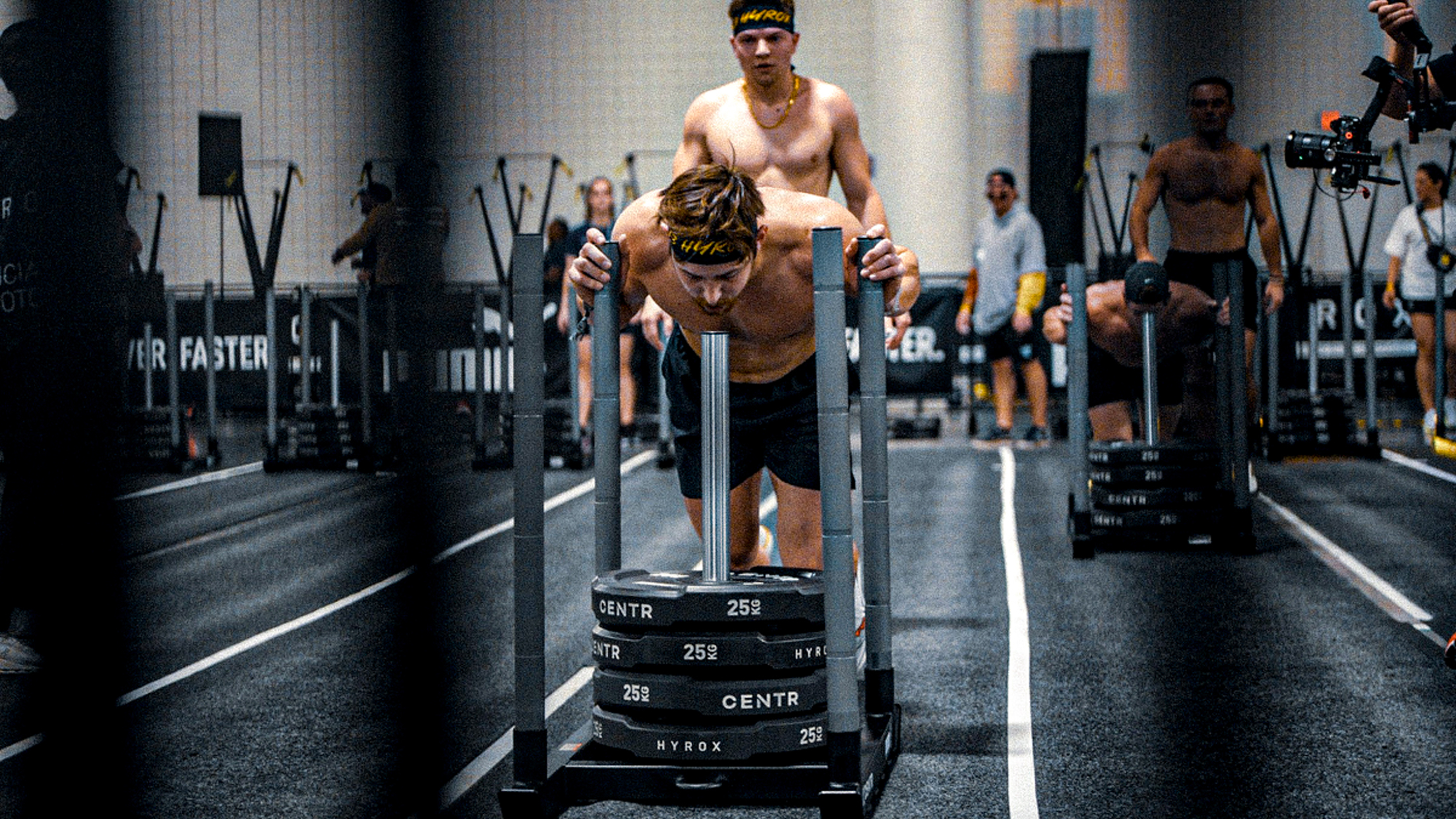
Ask any experienced HYROX athlete what advice they would give a first-timer, and almost every answer includes some version of the same warning: train the sled push specifically before race day.
The HYROX sled push is Station 2 — the second event in the race, coming after just one 1km run. Athletes are relatively fresh at this point. The weight doesn't look unreasonable on paper. And yet it's the station where the most first-timers fall apart, lose the most time compared to their potential, and leave feeling like they failed to execute something they should have been able to handle.
The reason isn't fitness. It's specificity. The sled push requires a body position, a force application pattern, and a type of muscular endurance that nothing else in standard gym training develops in the same way. If you haven't pushed a sled at competition weight before race day, you are genuinely underprepared — regardless of how strong or fit you are in every other dimension.
This guide covers everything you need to know about the HYROX sled push — the technique that makes it efficient, the common mistakes that make it brutal, and the specific training that builds the race-ready capacity the station demands.
HYROX Sled Push Weights by Division
Before technique — know what you're preparing for:
Open Division:
- Women: 102kg
- Men: 152kg
Pro Division:
- Women: 152kg
- Men: 202kg
Distance: 50 meters
The jump from Open to Pro sled weight — 50kg for both men and women — is where most athletes feel the most dramatic difficulty increase when moving to Pro. A 152kg Men's Pro sled push is a fundamentally different challenge from a 152kg Men's Open push. Plan your training based on your actual competition division.
Why the Sled Push Is Station 2's Secret Weapon Against Unprepared Athletes
The sled push is Station 2 in every HYROX race — early enough that athletes are not yet deeply fatigued from accumulated station work. You've run one kilometer. Your legs are warm. Your cardiovascular system is not yet taxed. On paper, this should be the most manageable heavy station in the race.
In practice, it's where the most dramatic time losses occur among underprepared athletes for three specific reasons:
The body position is highly specific. Pushing a sled efficiently requires a low, forward-leaning body angle with hips extended and arms applying force in a specific horizontal direction. This is not a movement pattern that squats, deadlifts, leg press, or any standard gym exercise specifically develops. It requires practice with the actual implement.
The force application is different from any other exercise. In the sled push, you're applying horizontal force into a friction-resisting implement using a bipedal striding pattern. The combination of foot-to-floor friction, horizontal force transfer through the arms, and continuous stride mechanics creates a demand that no barbell or dumbbell movement replicates.
Failure to maintain body position under fatigue compounds quickly. When an athlete's hip position rises during the push — when the low, horizontal angle degrades to a more upright posture — their mechanical advantage drops dramatically. An athlete who starts in good position and degrades to an upright push may lose 30–50% of their force application over the same distance, dramatically slowing their split.
The Correct Sled Push Body Position
Grip the handles low. The sled push handles should be gripped at a height that allows your arms to be roughly parallel to the floor when you're in your pushing position. This is lower than most people's instinct — gripping too high creates an upward force vector rather than a horizontal one, reducing how much of your effort actually moves the sled forward.
Hips down, back flat. Your hips should be below your shoulders, creating a forward-angled body position. A roughly 45-degree body angle is a reasonable starting reference — though the optimal angle varies by individual proportions. The key principle is that your force is being applied more horizontally than vertically.
Arms fully extended. Unlike a pushing movement where you might want a slight bend at the elbow for stability, the sled push is most efficiently done with fully extended arms throughout. Bent arms create a shock-absorption effect that reduces the force transferred to the sled.
Drive from the legs, not the upper body. The sled push is a leg-dominant movement. Your arms are the link between your legs and the sled — they transfer force but don't generate it in the primary sense. Drive your feet hard into the ground with each stride. Think about the floor contact as a push, not just a step.
Foot contact close to the sled. Each step should land relatively close to the front of the sled — not far behind it. Long, reaching steps reduce the force angle and create a pulling-back effect rather than a forward-pushing one. Short, powerful strides with foot placement close to the sled's back edge maintain the most efficient force application.
Head position. Eyes on the sled track directly in front of you or slightly down. A lifted head creates thoracic extension that disrupts the optimal body angle for pushing.
Common Mistakes and How to Fix Them
Mistake 1: Hips rise during the push.The most common technical degradation in the HYROX sled push is hips rising as the set progresses — either from fatigue or from initially poor setup. As the hips rise, the pushing angle becomes more vertical, dramatically reducing efficiency.
Fix: Practice maintaining hip position through the full 50 meters in training before moving to heavier weights. Use a cue like "chest to sled" to keep your torso angle down.
Mistake 2: Starting in an upright position.Many athletes who haven't specifically trained the sled push set up in a relatively upright position because it feels more natural. This creates an upward force vector from the first step — meaning a significant portion of their effort goes into compressing the sled rather than moving it forward.
Fix: Practice setting your body position before you begin pushing. Get into your low, forward-angled position with arms extended before you apply force. The transition from standing to pushing position should happen before the push begins.
Mistake 3: Short, shuffling steps.Some athletes attempt very short, rapid steps in the sled push. While step frequency matters, each individual step needs sufficient drive to actually accelerate the sled. Very short steps with insufficient power per stride produce a lot of foot movement but not much sled movement.
Fix: Focus on powerful individual strides rather than quick shuffling. Each foot contact should feel like you're aggressively driving into the floor.
Mistake 4: Attempting it first at race weight on race day.This needs no explanation, but it deserves emphasis: showing up to the North Texas Strength Expo HYROX race without having pushed a sled at competition weight in training is the single most preventable race-day mistake available to a prepared athlete.
Training the HYROX Sled Push
Phase 1: Learn the mechanics (Weeks 1–4)Use light-to-moderate weight — 50–60% of competition load — to develop body position and stride mechanics. Do not add weight until your technique is consistent and feels automatic. Film your pushes from the side to check hip position and body angle.
Phase 2: Build competition-weight exposure (Weeks 5–8)Work up to competition weight and above. Your goal by the end of this phase is to complete the full 50-meter competition distance at competition weight with good technique.
Key session: 5x50 meters at competition weight with 2–3 minutes rest. This builds both the strength and the specific conditioning the station demands.
Phase 3: Race simulation (Weeks 9–12)Push the sled after a 1km run at race pace to simulate the specific fatigue conditions of Station 2. This is the training stimulus that translates most directly to race-day performance — your body learns to execute the sled push with elevated heart rate and partial lower body fatigue from the preceding run.
Supplementary strength work:
- Leg press with full extension — builds the pushing strength with a similar hip/knee relationship
- Sled drags (backward) — builds hip extension strength in the pushing position
- Hip thrust variations — develops hip drive power specific to the horizontal force application
Race the Sled at the North Texas Strength Expo
The HYROX event at the North Texas Strength Expo in Mesquite, Texas features the sled push at all competition weights across Open, Pro, Doubles, and Relay divisions. The expo atmosphere — 5,000+ fans, five simultaneous national competitions — creates the kind of race environment where your trained technique is tested under real competitive pressure.
Prepare for it. Train it specifically. Arrive ready.

Train the sled. Race the expo. North Texas Strength Expo in Mesquite TX.Register for HYROX at ntxstrengthexpo.com



Find Us On
.svg)

.svg)