


Is HYROX Hard? What First-Timers Actually Experience on Race Day
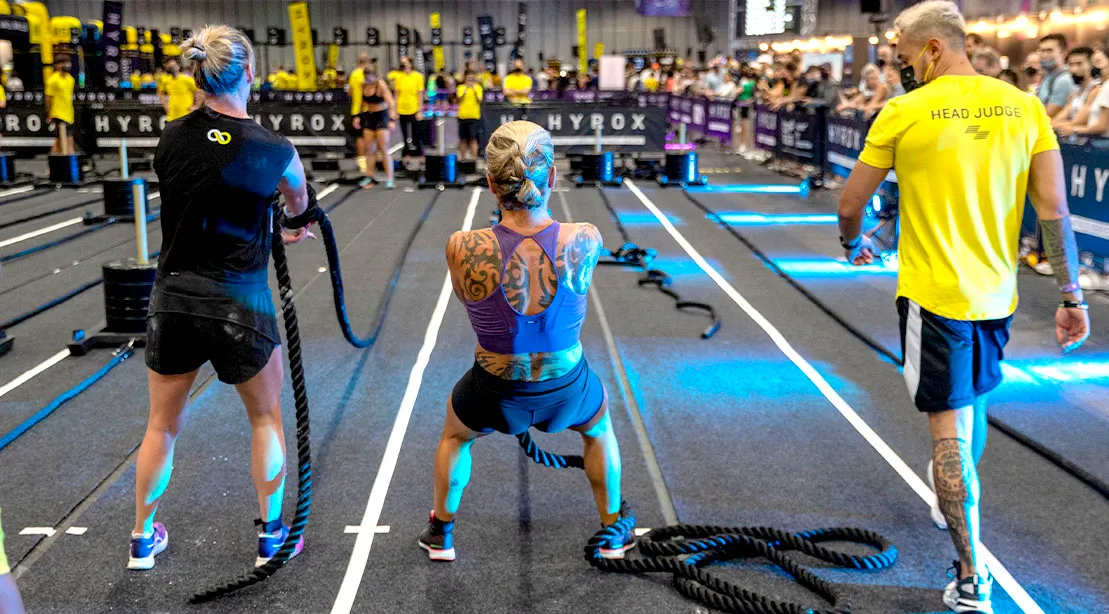
It's the question every person considering their first HYROX race types into Google at some point: is HYROX hard?
The honest answer is yes. It's hard. But it's hard in a way that's completely manageable with the right preparation — and the right preparation is far more accessible than most people assume before they start looking into it.
This guide gives you the complete, unvarnished picture of what HYROX actually feels like from start to finish, what surprises first-timers most, and what you can do to make your first race an experience you're proud of rather than one you're trying to forget.
First, What Is HYROX?
For anyone still orienting: HYROX is a standardized indoor fitness race with the same format at every event worldwide. Run 1 kilometer. Complete one workout station. Repeat eight times.
The eight stations, always in this order:
- SkiErg — 1,000 meters
- Sled Push — 50 meters
- Sled Pull — 50 meters
- Burpee Broad Jump — 80 meters
- Rowing — 1,000 meters
- Farmer's Carry — 200 meters
- Sandbag Lunges — 100 meters
- Wall Balls — 75 reps (Open division)
Total running: 8 kilometers. Total stations: 8. Total time for most Open division first-timers: 1 hour 20 minutes to 1 hour 45 minutes.
So Is It Hard? Here's the Real Answer
Yes — but not for the reason most people expect.
Most first-time HYROX athletes come from a gym background and assume the stations will be the hard part. The sled, the rowing, the wall balls — that's where they expect to struggle.
What actually happens is different. Most people find the stations manageable. What they underestimate — consistently and dramatically — is the effect of running 8 separate 1-kilometer efforts in an already-fatigued state.
By Station 5, your running pace has dropped. By Station 7, your legs have done things they haven't practiced in training. And by Station 8 — the wall balls — you're not dealing with a fresh set of 75 reps. You're dealing with 75 wall balls after 7 kilometers of running, two sled events, a row, carries, lunges, and burpees.
That's the honest difficulty of HYROX: it's an accumulation event. Each station is manageable in isolation. All of them together, separated by running, is a completely different challenge.
What Surprises First-Timers Most
1. The sled push is harder than it looks.
This is the single most common post-race comment from first-time HYROX athletes: "I did not expect the sled to be that hard."
The sled push at competition weight requires a specific body position — low, horizontal drive with full leg extension — that your body doesn't automatically default to. Athletes who haven't specifically practiced sled pushes at competition weight before race day often hit a wall here that costs them significant time and energy.
Train the sled. It cannot be replicated by any other movement in the gym. Find a facility with a sled and practice until the mechanics feel automatic.
2. The first kilometer sets the tone for everything.
Most first-timers start the opening 1km run too fast. It feels fine — you're fresh, adrenaline is high, the crowd at the North Texas Strength Expo is loud, and you're running what feels like a comfortable pace. By kilometer 3, you realize that pace wasn't sustainable for 8 repetitions.
Experienced HYROX athletes start the first kilometer at a pace that feels almost embarrassingly easy. They know the race is 8km long and they're running the whole thing on a budget that needs to last. The first kilometer should feel conservative. It should feel like you're leaving something in reserve. That reserve is what carries you through the back half of the race.
3. The sandbag lunges come at the worst possible time.
Station 7 — the sandbag lunges — arrives after 6.5 kilometers of running, two sled events, a 1,000m row, farmer's carries, and burpee broad jumps. Your legs at this point are not the legs you practiced lunges with at the gym. They're running legs that have been doing functional work for over an hour.
First-timers who practiced sandbag lunges fresh in training find that race-day lunges feel like an entirely different exercise. Practice lunges at the end of hard sessions specifically. Your legs need to learn what 100 meters of sandbag lunges feels like when everything else has already been spent.
4. The wall balls are a mental event.
By the time you reach Station 8, the physical difficulty is almost secondary to the mental challenge of starting and completing 75 wall balls when your body is telling you it's done.
The athletes who finish their first HYROX race strongly on wall balls are the ones who trained them consistently, trained them when fatigued, and arrived at Station 8 with a plan: break them into sets of 15–20, keep moving, don't stop for more than 5 seconds between sets.
The wall ball station is where HYROX ends and pure will begins.
What Makes HYROX Manageable for First-Timers
Here's what experienced HYROX athletes want first-timers to know: the difficulty is real, but it's entirely predictable and entirely trainable.
Unlike sports where difficulty comes from opponent-created chaos — unpredictable conditions, strategic complexity, physical contact — HYROX is always the same race. The same 8 stations in the same order with the same distances and the same weights. You know exactly what's coming and you can prepare for exactly what's coming.
That predictability is one of the sport's most powerful features for first-time competitors. There are no surprises on race day for athletes who have prepared specifically. If you've run 1km intervals and practiced each station at competition weight, you will be ready for what the race asks of you.
Is HYROX Right for You?
You're a good candidate for your first HYROX if:
- You have a regular fitness routine that includes some running and gym work
- You can run 5km without stopping
- You have access to most of the stations or a gym that can help you practice them
- You're motivated by a concrete, measurable performance goal
- You want a race where you can directly compare your result to a global field
You might want to build more base first if:
- You're currently running less than once per week
- You've never used a rowing machine or SkiErg
- The idea of running 8 separate kilometers makes you genuinely uncertain
- Your current gym routine is entirely machine-based without functional movements
If you're in the second category, six to eight weeks of base building before starting the 12-week training plan puts you in a strong position. HYROX rewards athletes who prepare — and the preparation itself is rewarding.
Race HYROX at the North Texas Strength Expo
The North Texas Strength Expo in Mesquite, Texas features HYROX as a featured national competition alongside Strongman Corporation Nationals, Powerlifting America, the United Grid League, and Arm Lifting.
Racing HYROX inside a full national strength expo is one of the best possible environments for a first race. The crowd energy, the simultaneous competitions creating ambient buzz throughout the building, and the strength community atmosphere all contribute to performances that first-timers consistently describe as better than they expected.
Open, Pro, Doubles, and Relay divisions are available. For most first-timers, Open is the right call — competitive, well-attended, and designed to give every fitness level a meaningful race experience.

Yes, HYROX is hard. You'll be fine. Sign up at the North Texas Strength Expo.Get registered at ntxstrengthexpo.com



Find Us On
.svg)

.svg)