


The Farmer's Carry — The Complete Guide for Strongman and HYROX Athletes
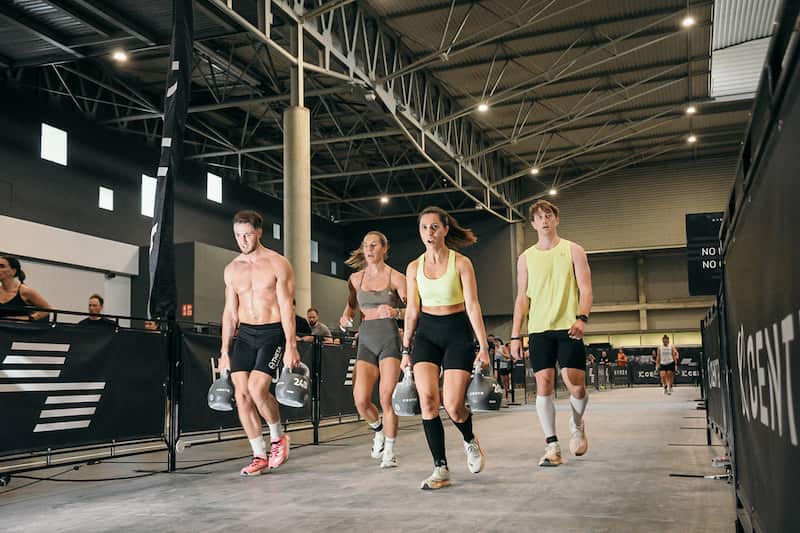
The farmer's carry is one of the most honest tests of physical capability in competitive strength and fitness sport. Pick up two heavy implements — one in each hand — and walk with them as fast as possible over a set distance. That's it. No technique tricks that bypass the strength requirement. No mechanical advantage to exploit. Just you, the weight, and the floor.
The farmer's carry appears in both strongman competition and HYROX racing — and while the implement weights and distances differ significantly between the two sports, the physical demands and the training principles that improve performance are more similar than most athletes realize.
This guide covers the complete picture: how the farmer's carry works in both sports, the technique fundamentals that determine whether you move fast or fight every step, and the specific training methods that build the grip endurance, core stability, and postural strength the event demands.
The Farmer's Carry in Strongman vs HYROX — What's Different
In strongman competition at events like Strongman Corporation Nationals at the North Texas Strength Expo, the farmer's carry is typically performed over a 50–80 foot course with implements loaded to 250–400+ pounds per hand at national competition level. Athletes are racing for time — fastest finish wins — and the loads are genuinely maximal. The grip failure risk is high and the event tests both maximum grip strength and loaded locomotion speed.
In HYROX, the farmer's carry is Station 6 — a 200-meter carry using 2x16kg kettlebells for women and 2x24kg for Open Men (heavier in Pro division). The distance is significantly longer than a strongman course and the weights are lighter relative to competition body weight. However, the farmer's carry in HYROX arrives after five previous stations including two sled events, 5km of running, and 1,000m of rowing. The grip and postural fatigue accumulated by Station 6 means the lighter weights feel much heavier than they would in isolation.
As Elite 15 HYROX athlete and 2025 London Women's Pro Doubles champion Sinéad Bent put it: "It's not just about grip strength — though that's huge — it's about posture and composure under fatigue."
Both sports reward the same foundational qualities. The athlete who has developed serious farmer's carry capacity — grip endurance, core stability under loaded locomotion, and postural control over distance — performs better in both contexts.
Technique Fundamentals That Apply to Both Sports
The pickup — hinge, not squat.Approaching the farmer's carry handles from a squat position is a technical error that costs energy before the carry even begins. The correct setup is a hip hinge — feet centered at the handles, hips back, neutral spine, handles gripped at the outside. Drive through the heels as you stand, bringing the hips through to full extension. This is the same pattern as a conventional deadlift, not a goblet squat. Starting from a squat position lengthens the range of motion unnecessarily and wastes energy on the lift-off.
Grip the handle hard from the start.Your grip engagement needs to be maximal from the moment you close your hand on the implement — not something you build into as you start walking. A partial grip at the start leads to the handle rotating in your hand as fatigue sets in, which is harder to recover from than starting with full grip engagement.
Shoulders back and down, chest up.The most common postural failure in the farmer's carry is allowing the shoulders to round forward under the weight. This compresses the thoracic spine, reduces grip efficiency, and makes breathing harder. Think "proud chest" — shoulder blades retracted and slightly depressed, sternum lifted. Elite athlete and HYROX competitor Jake Williamson specifically notes that posture and composure under fatigue are what separate efficient carriers from those who lose time by fighting the implements.
Short, quick steps over long strides.Long strides create more lateral oscillation — a swing in the implements that compounds with each step and drains energy managing the instability. Short, quick steps maintain consistent ground contact, reduce implement swing, and allow you to maintain direction more efficiently. This is the same principle as the yoke carry and for the same biomechanical reason.
Look forward, not down.Watching the implements or watching your feet creates a forward head position that disrupts the thoracic extension needed for good posture. Pick a fixed point at the end of the course or at horizon level and keep your gaze there throughout the carry.
Breathe continuously.Unlike a maximum-effort deadlift where a held breath is appropriate, the farmer's carry requires continuous breathing through the duration of the effort. Holding your breath while carrying creates respiratory fatigue on top of grip and postural fatigue. Breathe in rhythm with your steps — typically one full breath cycle every 4–6 steps at competition pace.
The Grip Component — What's Actually Limiting You
Most athletes who feel like the farmer's carry is a weakness are actually experiencing a grip limitation rather than an overall strength limitation. Their legs and back are capable of more than their hands can hold.
This is the specific insight that separates efficient farmer's carry training from generic strength work: grip is the limiting factor, and grip requires specific development.
Your deadlift PR does not translate directly to your farmer's carry performance. Static grip strength — holding a bar at lockout for a fraction of a second — is different from dynamic grip endurance — holding heavy handles for the full duration of a loaded carry course. Athletes with 400-pound deadlifts frequently discover their farmer's carry performance lags significantly because the sustained grip demand of a long course is a different quality than the grip peak in a max deadlift.
What to train for grip-specific farmer's carry improvement:
Timed static holds: Load farmer's carry handles or a trap bar to near-competition weight and hold for 20–40 seconds without walking. This builds the specific sustained grip endurance that the carry demands without the cardiovascular fatigue of the full carry.
Long-distance carries at moderate weight: 100–200 meter carries at 60–70% of competition weight build grip endurance and postural stability over distance. These feel easier than maximum-weight carries but accumulate specific adaptation in the tissues that competition loads demand.
Fat grip work: Training any pulling movement with thick grips (Fat Gripz attachments or an axle bar) forces greater hand muscle recruitment and builds grip capacity faster than standard barbell training. Two months of consistent fat grip deadlift work typically produces measurable improvement in farmer's carry grip endurance.
Towel or rope holds: Hanging from or holding a towel or rope recruits the hand in a wrapped grip position that develops support grip specifically — the quality needed to sustain the farmer's carry over distance.
Strongman-Specific Training Notes
For strongman athletes preparing for farmer's carry competition, there are specific considerations beyond the general technique guidance:
Train both the pick and the carry. Many competition farmer's carry failures happen at the pick — a fumbled setup that creates a twisted grip or an awkward start position. Practice the full movement from setup to finish, not just the carry phase.
Train your turns. Competition courses often involve a 180-degree turn at the halfway point. Turning efficiently with heavy farmer's carry implements is a specific skill that requires practice. A wide, smooth arc turn that doesn't require stopping is significantly faster than a stopped pivot.
Practice dropping and recovering. If you drop the implements mid-course in competition, you need to recover efficiently — re-gripping, resetting, and continuing without panicking. Practice intentional drops in training to build the recovery mechanics that competition requires.
Train at competition distance with competition weight regularly. Not every session needs to be at maximum weight — but you need regular exposure to full competition distance at competition weight to develop the specific adaptation that race-day performance demands.
HYROX-Specific Training Notes
For HYROX athletes, the farmer's carry training priority is developing the composure to execute good technique at Station 6 when everything else is already fatigued.
Train the farmer's carry at the end of hard conditioning sessions — after rowing intervals, after sled work, after running — so your body learns to maintain grip and posture when your cardiovascular system is already stressed. Practicing farmer's carries fresh builds general strength; practicing them fatigued builds the race-specific quality that Station 6 demands.
The HYROX farmer's carry distance of 200 meters requires specific endurance training rather than maximum-weight training. 3x200-meter carries at competition weight or slightly above, with 2–3 minutes rest between sets, is a highly effective session for building HYROX-specific farmer's carry performance.
See the Farmer's Carry Live at Both Events
The North Texas Strength Expo in Mesquite, Texas features farmer's carry competition at Strongman Corporation Nationals — national-level athletes moving competition weight over the full course at race speed — and HYROX racing where Station 6 plays out as part of the full eight-station race.
Watching elite athletes execute the farmer's carry under competition conditions shows you technical details that no description fully captures. The posture of a clean carry versus a degrading one. The stride pattern that maintains speed. The grip adjustment between the pickup and the walk.

See the farmer's carry at the national level — live at the North Texas Strength Expo.Get your tickets at ntxstrengthexpo.com



Find Us On
.svg)

.svg)